Forgive them NOT, Father, for They KNOW What They Do!" Christ's Own Words Expose Canonical Error
- Tara Melchizedek
- Dec 3, 2025
- 5 min read

On Forgiveness, Retaliation and Wisdom:
Luke 23: 34 is a verse concerning the words of Christ as he hung on the tree/ cross and was getting ready to die. It is usually quoted as something akin to, Jesus said, “Father, forgive them, for they do not know what they are doing.”[a] And they divided up his clothes by casting lots.
This is one of the most used verses to encourage slave mentality from the faithful, a sort of programming that suggests that to be Christ like means we must always forgive at any cost and are not supposed to defend ourselves.
This may also be one of the most catastrophically mistranslated verses in existence and the evidence of a conspiracy to cover up the real meaning of it is evident all over. The original Greek reads:
ὁ δὲ Ἰησοῦς ἔλεγεν· πάτερ, ἄφες αὐτοῖς· οὐ γὰρ οἴδασιν τί ποιοῦσιν.
According to the Interlineal Bible the actual translation reads; "And Jesus was saying, Father forgive them not, for they know what they do. Dividing then the garments of him, they cast lots. Here is a screenshot from the Interlineal Bible:
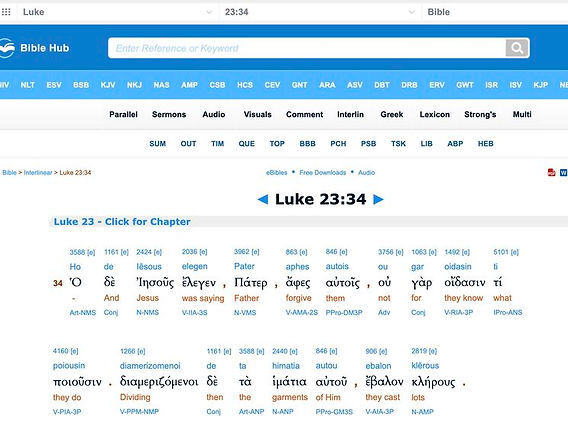
If we take a moment to think critically about the scenario being described it does not make sense that they would not know what they are doing, casting lots is the equivalent to a form of gambling or for divination purposes, similar to rolling dice but sometimes to tell the future. They knew exactly what they were doing and they were so comfortable with it, they intentionally had fun trying to profit off of it right in front of him as he died.
I could not find a single translation though on the Bible Gateway search engine that had anything other than the exact opposite message as the published text, but isn’t it suspicious that in the footnotes there is a message that says, “some manuscript omit this sentence.”!
The verse is so problematic and it is so unwelcome by the hierarchy of social powers in the field of religion to challenge the well known misquoted version, that Bible publishers left it out completely to avoid the issue altogether. Here is a screenshot from one of the searches as an example:

The subject of forgiveness to the extreme is also often taught to believers with the phrase, “But whoever slaps you on your right cheek, turn the other to him also. “ from Mathew 5:39, but the teaching in it’s fullness reads:
Retaliation
Mathew 5:38 “You have heard that it was said, ‘An eye for an eye and a tooth for a tooth.’ 39 But I say to you, Do not resist the one who is evil. But if anyone slaps you on the right cheek, turn to him the other also. 40 And if anyone would sue you and take your tunic,[h] let him have your cloak as well. 41 And if anyone forces you to go one mile, go with him two miles. 42 Give to the one who begs from you, and do not refuse the one who would borrow from you.
This is a particularly juicy piece of scripture to chew on for the critical thinker, because if one is savvy enough to really research the culture and spiritual law, it will be revealed to the seeker that it is not about simply bowing down for your abuser, but using wisdom to outsmart them instead of setting yourself up for a harder blow, perhaps by more offenders. Let me explain first the aspect of spiritual law, which is basically what many people these days call Karma or in the Bible we see it clearly in Galations 6:7 Be not deceived; God is not mocked: for whatsoever a man soweth, that shall he also reap.”
In layman's terms, we get what we give and that is an actual universal law that makes the world what it is, when we examine verses 40-42 we find that what is being suggested is to use wisdom to defend and reap justice instead of brute force or engaging in the fight in a manner that would bring back more of what you are trying to stop.
An eye for an eye makes the whole world blind, is another way of expressing the consequences of retaliation and revenge. Just because we have a court system does not mean we are guaranteed justice, there is such a thing as corruption and systemic prejudice, but how we CAN gain from the crime against us is to give them even more, so that “karmically” speaking although they won the battle and took what they wanted, when you give to them even more, you become the lien holder to the debt and are then owed by the universal law of reaping what you sow.
The world is not fair, until the age of peace comes and people with the mind of Christ reign over our world political system and war theater, we can expect it will remain this way and so in times of being taken from, give more and find yourself gaining at some point. We must consider the practical application of scripture including culture to understand scripture, here is another verse that further warns against the corruption of this world and it’s justice.
Mathew 5:25 “Settle matters quickly with your adversary who is taking you to court. Do it while you are still together on the way, or your adversary may hand you over to the judge, and the judge may hand you over to the officer, and you may be thrown into prison.”
The instruction in Mathew 5:38-42 is about safety first and using wisdom to gain a foothold against your enemy instead of retaliation. This brings us to the first verse about turning the other cheek and when we research the culture when this teaching was being dispensed we find there is something hidden, but very pertinent to understanding the wisdom in the Messiah’s advice. The following excerpt is taken from:
“ In Jesus’ day, hitting a person on the cheek was a forceful insult, but it was not considered a violent assault. Here, Jesus is specifying a strike on the right cheek, which implies a back-handed slap. Striking someone with the back of the hand (3) could demand a doubled fine because it was “the severest public affront to a person’s dignity.” (4)
But Jesus is not suggesting that his followers should stand around and take abuse. First, turning the left cheek was a bold rejection of the insult itself.
Second, it challenged the aggressor to repeat the offense, while requiring that they now strike with the palm of their hand, something done not to a lesser but to an equal. In other words, turning the other cheek strongly declares that the opposer holds no power for condescending shame because the victim’s honor is not dependent on human approval—it comes from somewhere else. (5) This kind of action reshapes the relationship, pushing the adversary to either back down or to treat them as an equal.”
Tara of Melchizedek

Comments